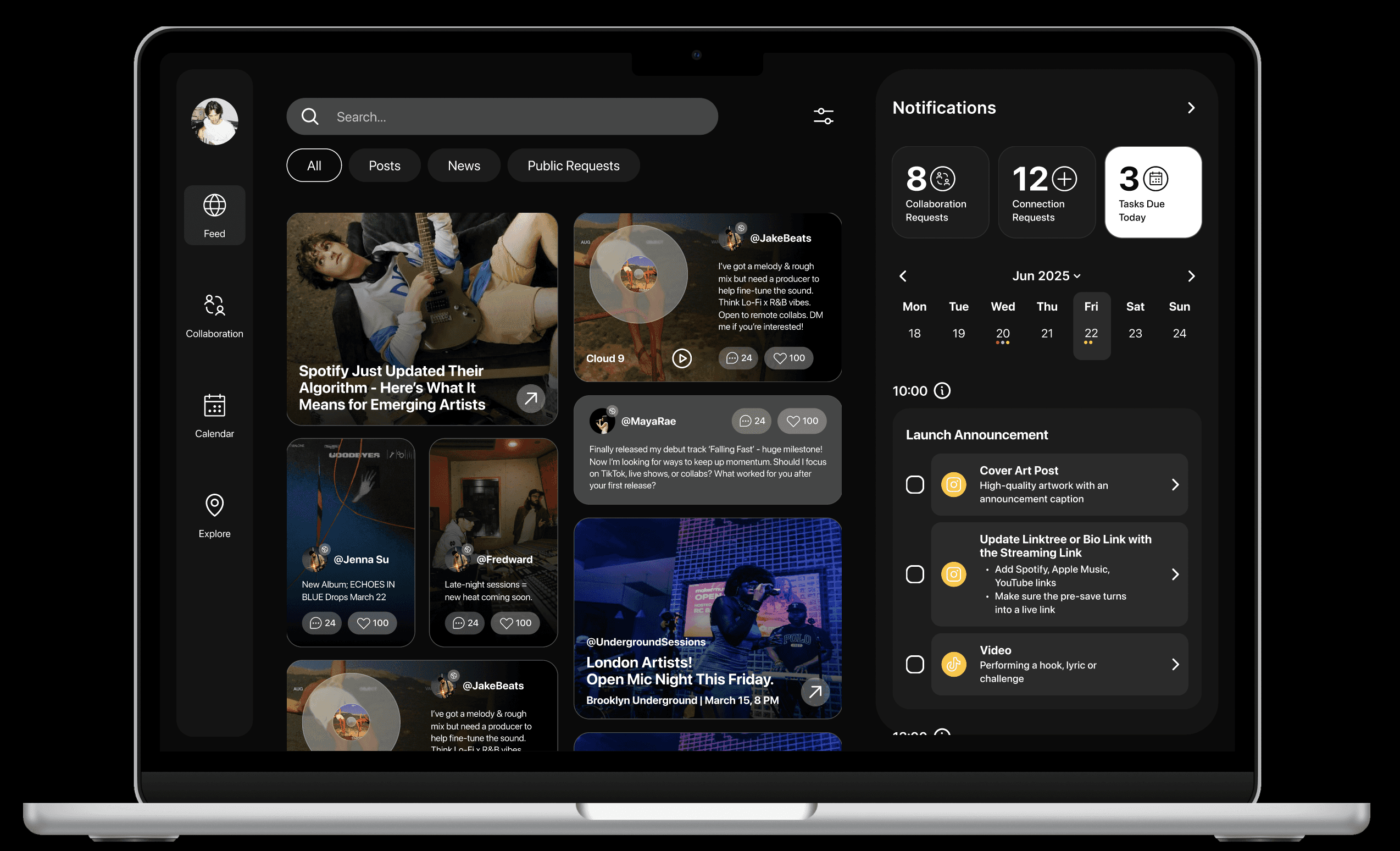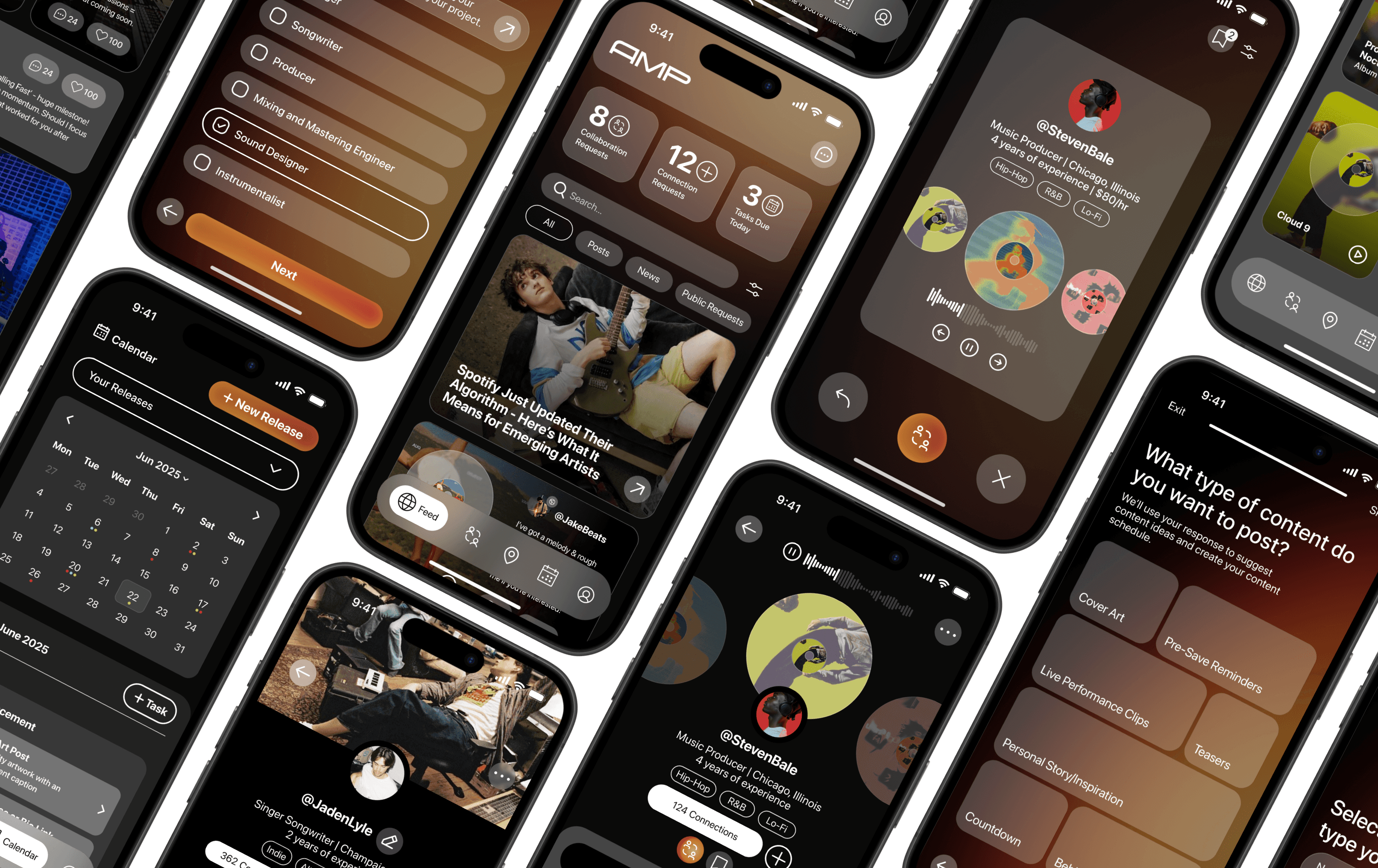

THE PROBLEM
The digital revolution has reshaped the music industry. Today’s landscape is defined by streaming platforms, social media, and algorithm-driven promotion.
While technology has democratized music distribution, it has also led to an oversaturated market, making it increasingly challenging for new talent to stand out.
It offers a wide range of financial products including credit cards, loans, and investment services. The website plays a key role in customer acquisition, allowing users to explore products, compare benefits, and submit applications online.
SECONDARY RESEARCH
70%
of musicians face challenges getting heard in a saturated space, where standing out feels increasingly out of reach. (Source)
88%
of new artists struggle to understand algorithms & build promotion strategies, making marketing a challenge. (Source)
62%
of artists find it difficult to grow and sustain audiences limiting their reach, and long-term career progression. (Source)
PRIMARY RESEARCH
To better understand the behaviours, motivations, and pain points of emerging musicians, I conducted interviews with 4 artists at different stages of their creative journeys.
This included singer/songwriters and producers who were either actively releasing music or consistently collaborating with others. From affinity mapping, I found 4 key themes that I took forward with me into the next stages of the project.

Post-Release Promotion Is Exhausting and Unstructured
MOTIVATION
"I need a consistent content strategy in order to get the songs the attention I think they deserve."
BEHAVIOUR
"If there was someone else that could do it for me, I’d definitely just hand that off."
PAIN POINT
"It takes a lot of time and effort to just keep it up."
Avenues for Feedback & Growth Aren't Streamlined
MOTIVATION
"Technical feedback, like mixing and mastering, is something almost every musician would want."
BEHAVIOUR
“If I'm recording with my friend who's the producer … I'll usually ask him, "what do you think about this decision? I think I can deliver that better?”"
PAIN POINT
“The thing you think is the thing is the best from you might not be from you might not what other people think is the best from you.”
Financial Instability is a Major Stressor
MOTIVATION
"That’s why I want to get a job - so I can fund my music career and not have limitations on who I can work with or where."
BEHAVIOUR
"I can’t afford to spend thousands on music videos yet, so I have to be creative with what I have."
PAIN POINT
"Financially, the instability of music income is why I don’t pursue it full-time."
Networking Feels Random and Unfiltered
MOTIVATION
“I’m pretty involved in music communities here in Urbana and trying to cultivate that community as well.
BEHAVIOUR
"Networking is everything. My friend is headlining a 500-person venue and might ask me to open for him."
PAIN POINT
“It's hard to filter people that you want to connect with and the tricky thing ... is that it's hard to find people who are roughly the same level as you.”
OPPORTUNITY SELECTION & REDIRECTION
The insights I found through research marked a major shift in the product thinking moving forward.
What began as a visibility-focused exploration would now evolve into a more holistic outlook on the problem space where a digital solution could support musicians not just in being seen, but in career navigation and the work that goes into the backend of making, sharing and performing music.
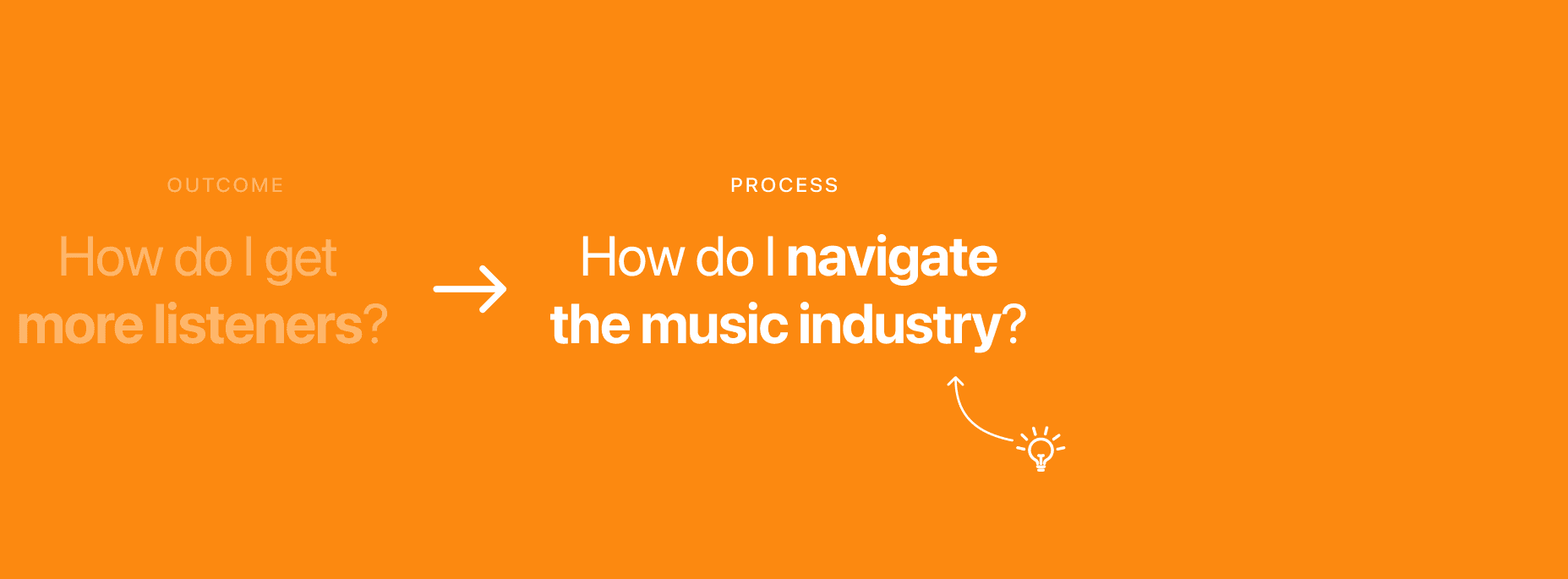
HOW MIGHT WE QUESTION
PERSONA
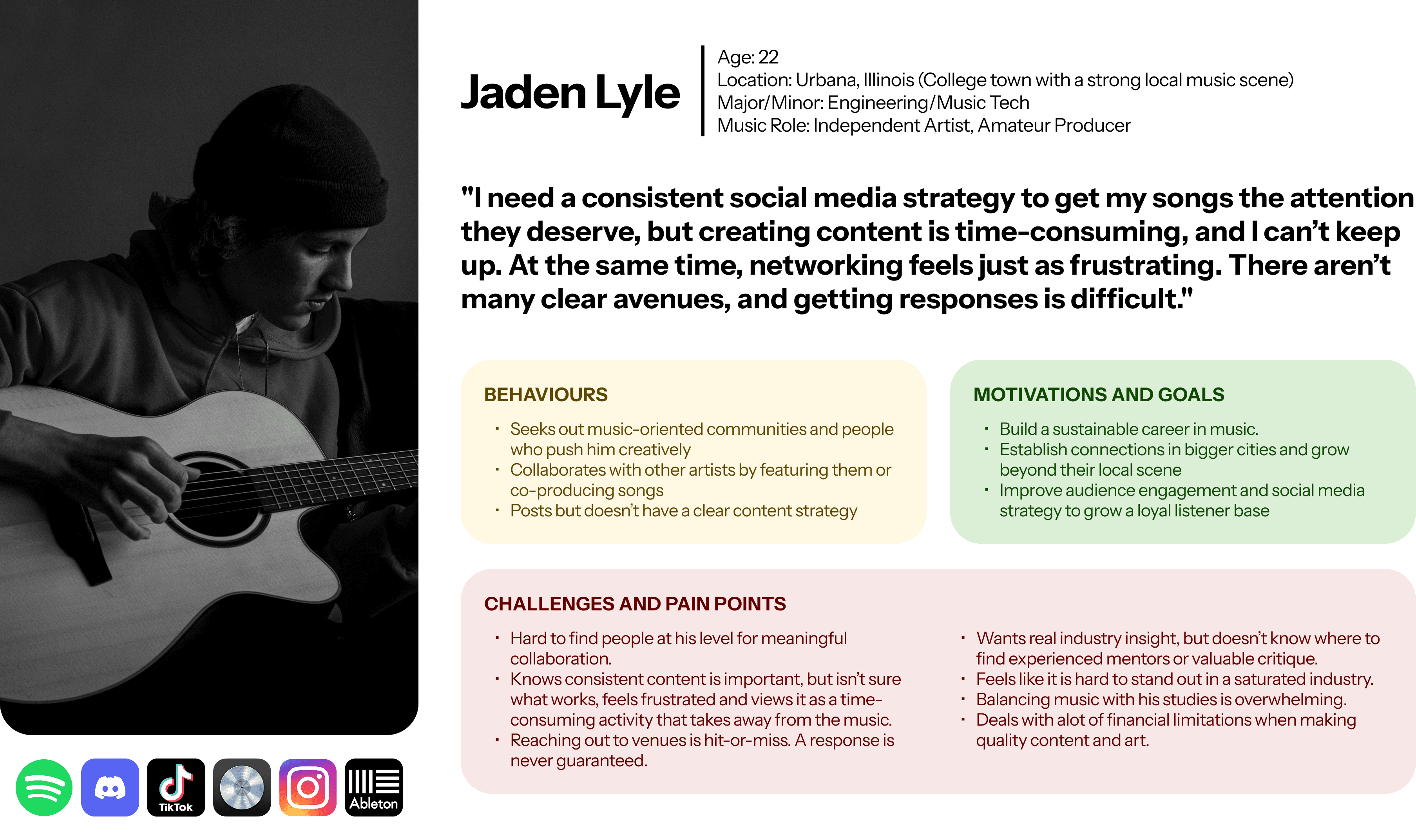
Introducing Jaden, the fictional, research-backed persona who represents the interviewees that I had conversations with.
Developing a clear artifact helped me visualize exactly who I was designing for and became a resource to come back to throughout the process.
EXPERIENCE MAPPING
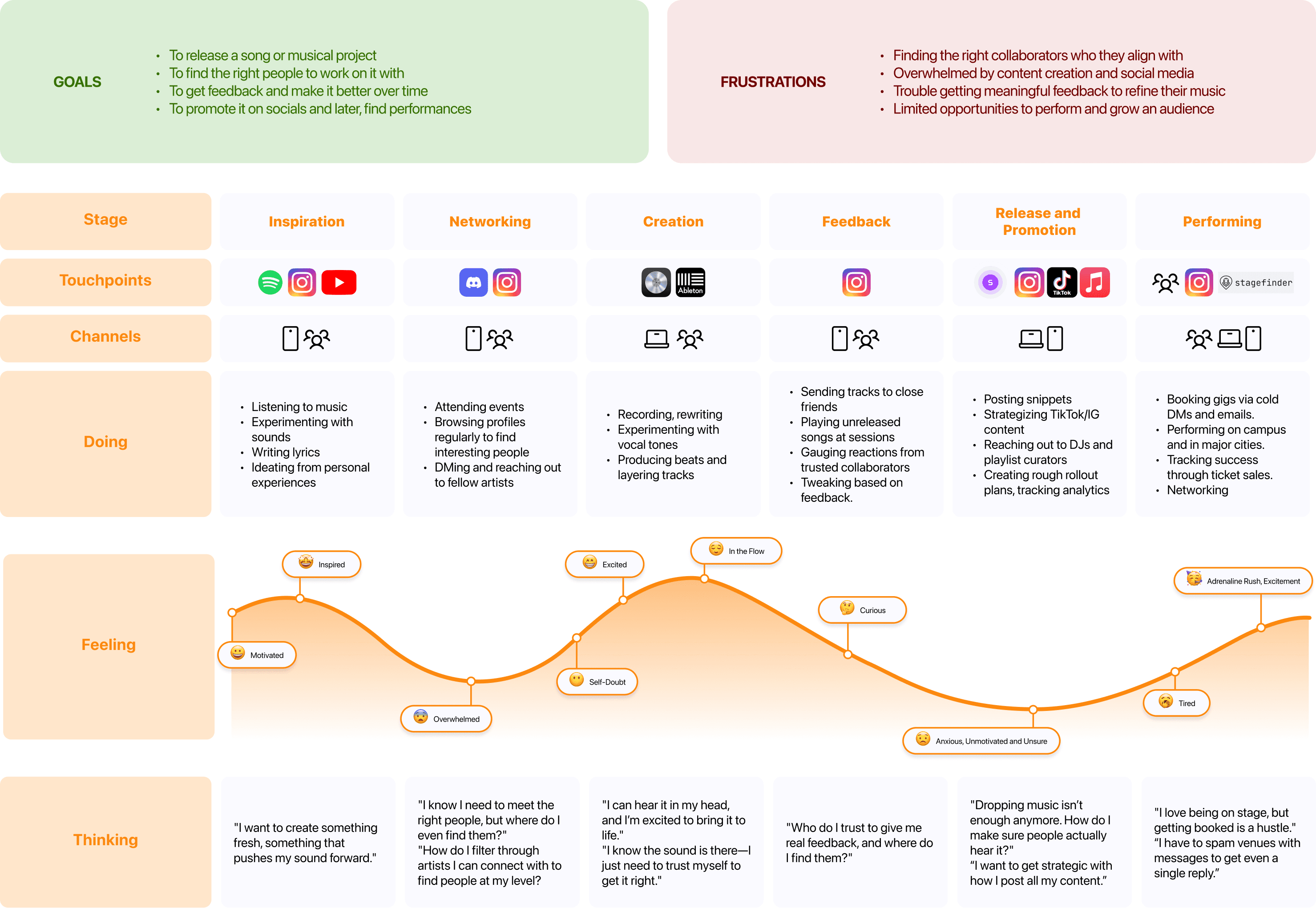
Creating an experience map helped me understand the exact journey that an artist goes through to release and promote music.
Having this laid out assisted in building the foundations of my knowledge of the problem space with a focus on the user. It also helped empathise with them better and identify areas for design intervention.
TASK FLOW DETERMINATION
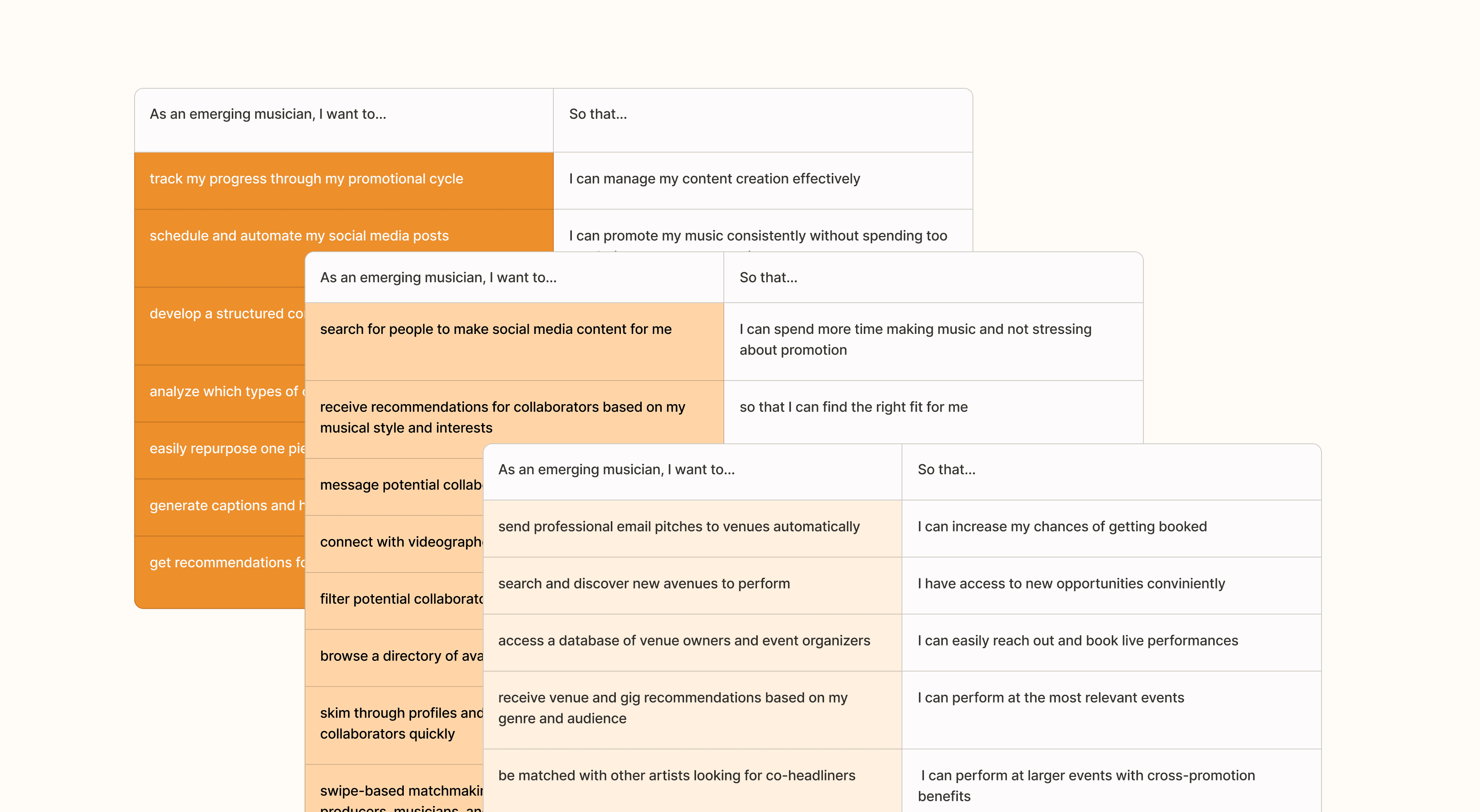
To ensure the platform addressed user needs and prioritized them, I translated user research insights into user stories. These helped me define functional requirements from the user’s perspective.
Once I had a set of user stories, I grouped them into epics that reflected key areas of the product. The three epics I picked were,
1
Finding Well-Matched Collaborators
2
Managing Online Presence and Promotion
3
Scheduling Performance Opportunities
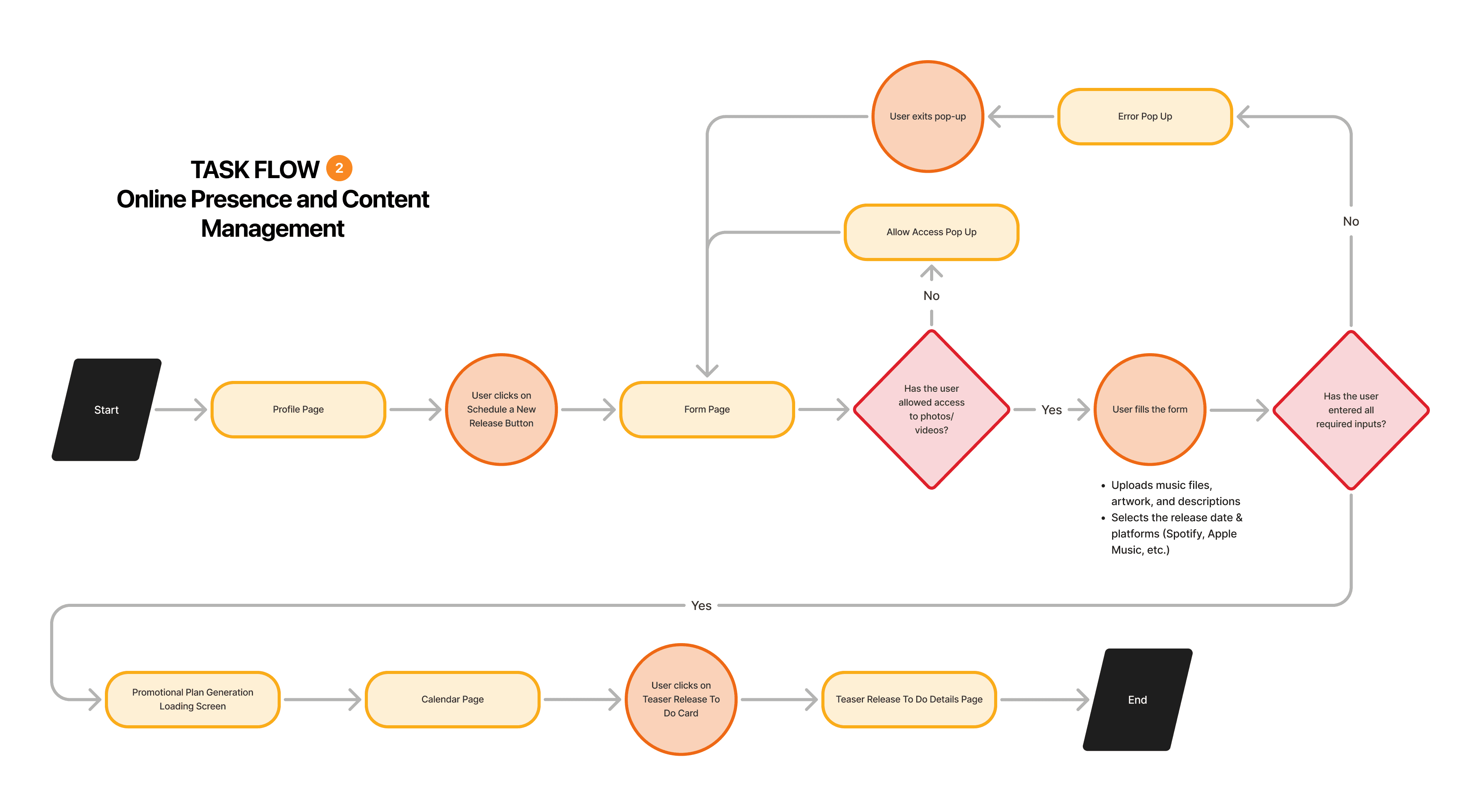
SELECTING TASK FLOWS
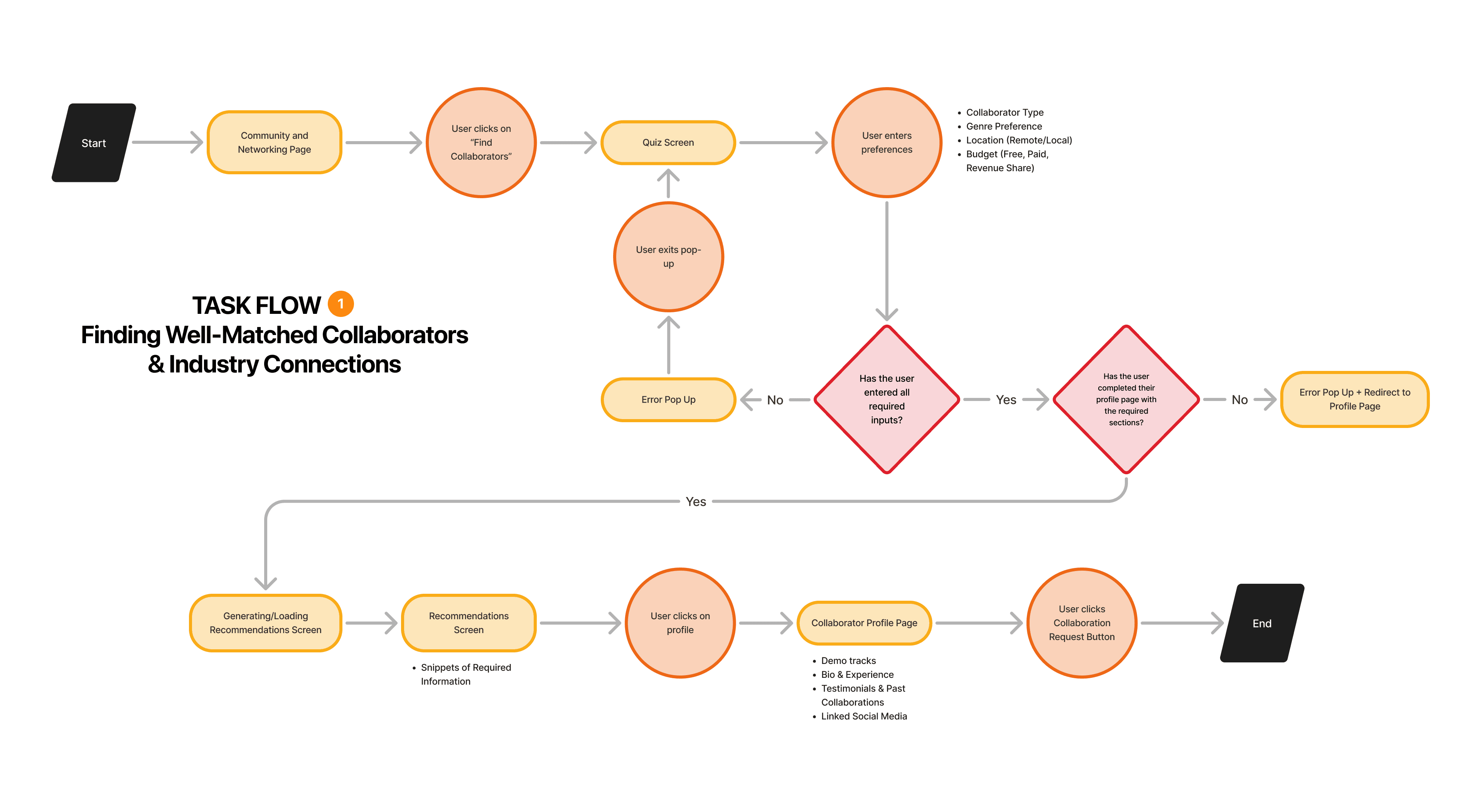
Having understood the main value my product would try to bring, I narrowed my focus down to the first two epics for the sake of time and scope of the project.
Instead, I decided to do a bit of concept testing on the last one during my user testing sessions and still consider the feature as a part of the application as organically as possible as if it were prototyped.
1
Finding Well-Matched Collaborators
2
Managing Online Presence and Promotion
3
Scheduling Performance Opportunities
PHASE 3 - DESIGN
COMPETITOR ANALYSIS
A competitor analysis revealed that there was a gap in the market for an artist-first career navigation platform.
While tools like Instagram and Fiverr were supportive of artists and main platforms for them to find an audience, collaborators and resources, they were too broad, didn't cater to the music industry specifically and weren't built for quick and efficient demo sharing. On the other hand, platforms like ReverbNation were too technical and focused mainly on marketing and analytics tools that felt tough to get a hand of.
An open marketplace for musicians and creatives to find paid work and collaborate, but lacks social engagement or promotional tools.
Helps musicians find gigs and promotes their work with marketing tools, but lacks networking or collaboration features.

A real-time collaboration tool with a built-in DAW and social engagement but limited gig-finding and promotional support.
Musicians use Instagram to build their fanbase and market their music, but gig-finding and collaboration are not structured or music-focused.
Acts as a networking platform for musicians, allowing them to connect, but lacks gig opportunities or promotional planning.
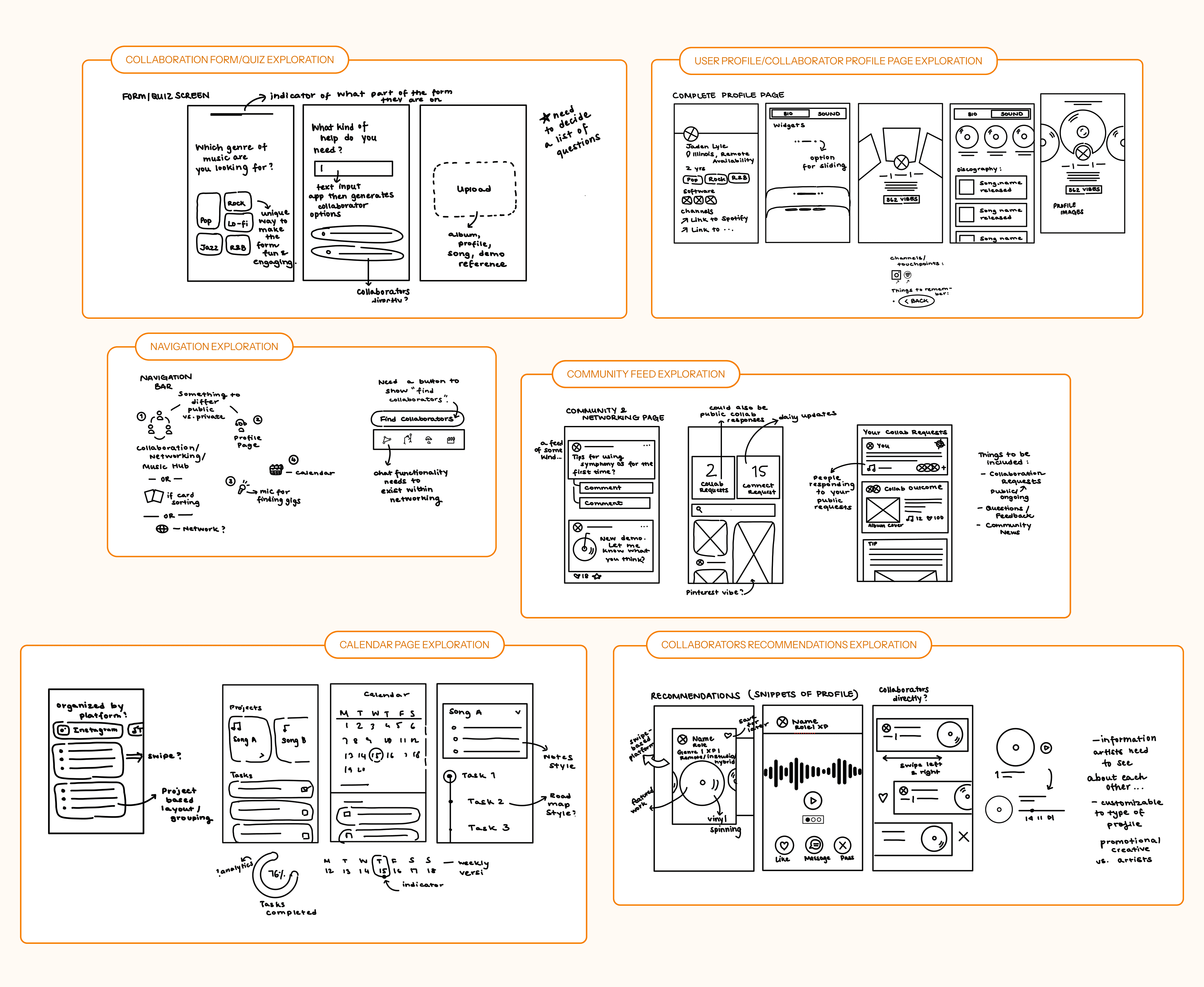
INITIAL SKETCHES
My main goal was to maintain a balance between existing mental models and traditional mobile app patterns while also making the experience feel just as unique, special and creative as my users.
I first explored existing mobile app patterns that employed similar interactions. I looked beyond the music space, drawing inspiration from:
-
Dating apps that matched users to one another
-
Scheduling and calendar-based components for the promotional planning screens
-
Onboarding flows of all kinds to get inspiration for the quiz screens to learn about the user
-
LinkedIn profiles to look at the way layouts were structures for high content volume
From there, I began sketching exploratory ideas. These evolved into solution sketches that helped me visualize how features would come together as a final cohesive flows.
WIREFRAMES AND USER TESTING
After creating a mid-fidelity prototype based on my chosen sketches, I conducted usability testing with 10 users within my participant criteria to evaluate how intuitive the product appeared to them and whether it supported their existing workflows.
While users were able to complete core tasks without major friction, the sessions helped me uncover subconscious mental models that my users had, improve copy to align with music industry terminology, enhance feature functionality, and make the experience more tailored to how artists actually collaborate, plan, and promote in their day-to-day.
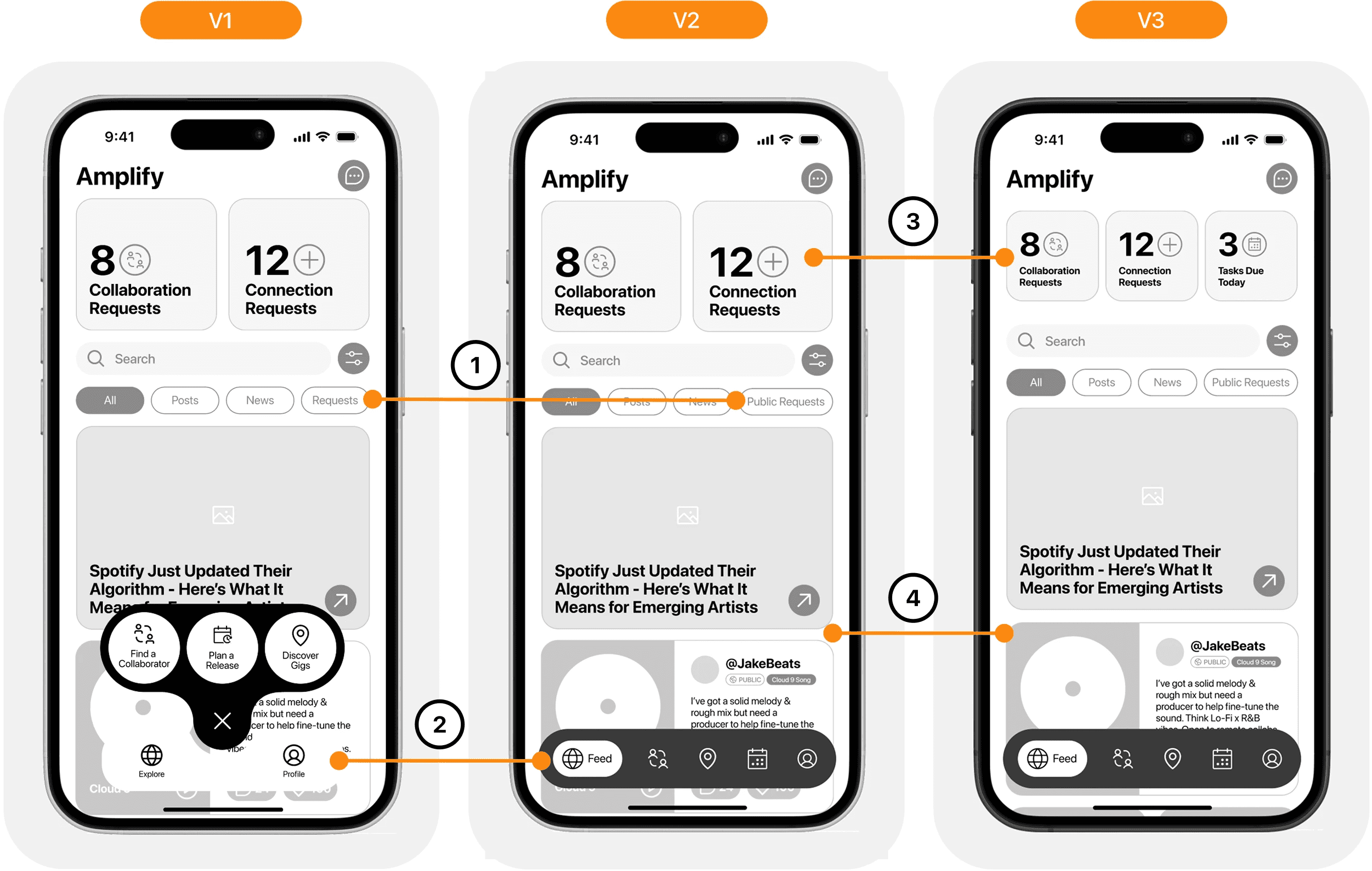
HOME/FEED PAGE
Version 2
1
Updated UX copy of filter names for better clarity
2
Created an updated navigation bar. Instead of being action-focused, more general and scalable
Version 3
3
Added a third widget for tasks due daily as users felt they would check that the most often and use it as both a reminder and a shortcut
4
Minute spacing adjustments between posts for readability

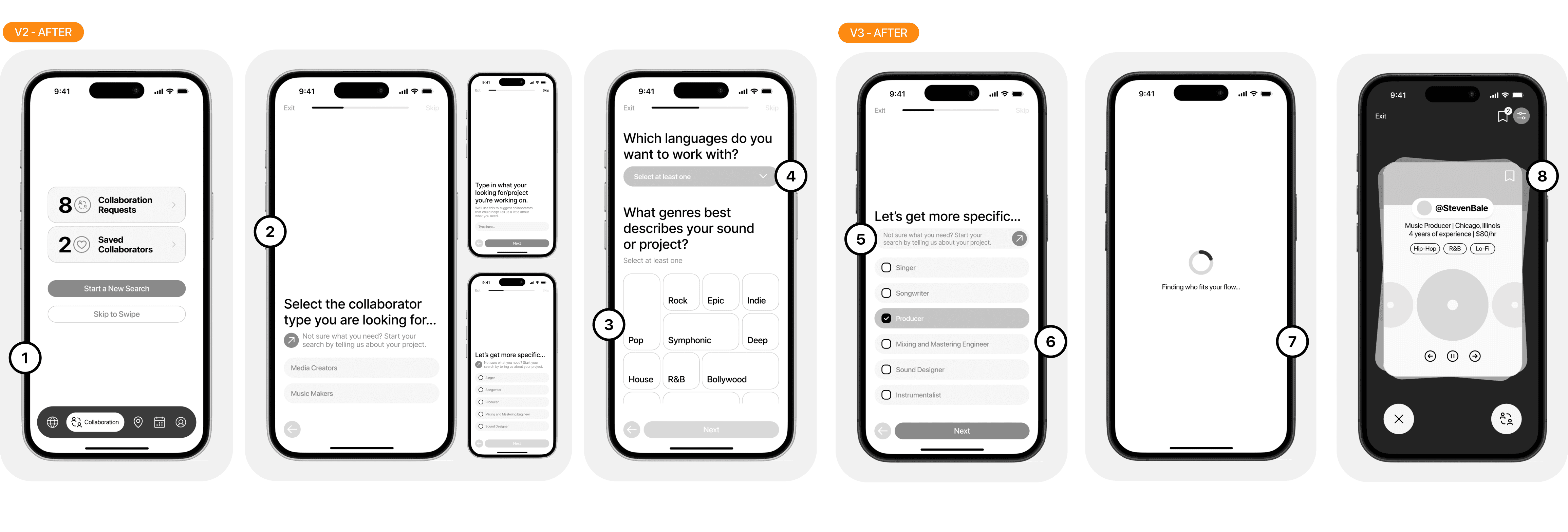
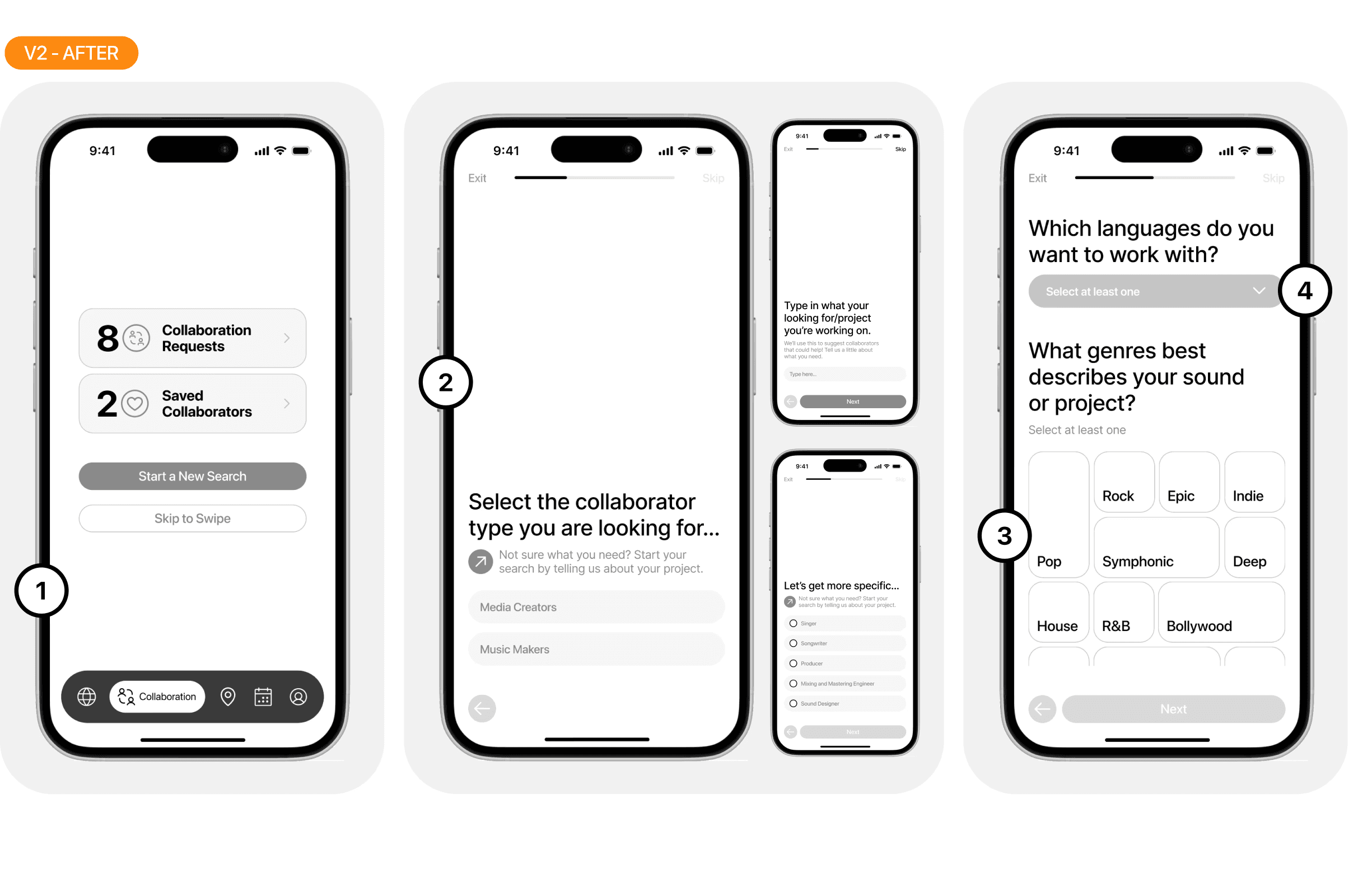
COLLABORATION TASK FLOW ITERATIONS
Version 2
1
Added a standard dashboard for the collaboration flow before the quiz
2
Altered the order in which questions were presented in the form to better suit user preferences
3
Added more genre options for better inclusivity
4
Added more language options for better inclusivity
Version 3
5
Changed button format for better recognizability
6
Changed selection method to checkboxes with a less rounded edge to signify multiple selection clearly
7
Added a loading screen to align with user's mental models and allow time for the system to generate recommendations
8
Change heart icon to bookmark icon to save collaborators to avoid confusion between what was the primary versus secondary action on the screen
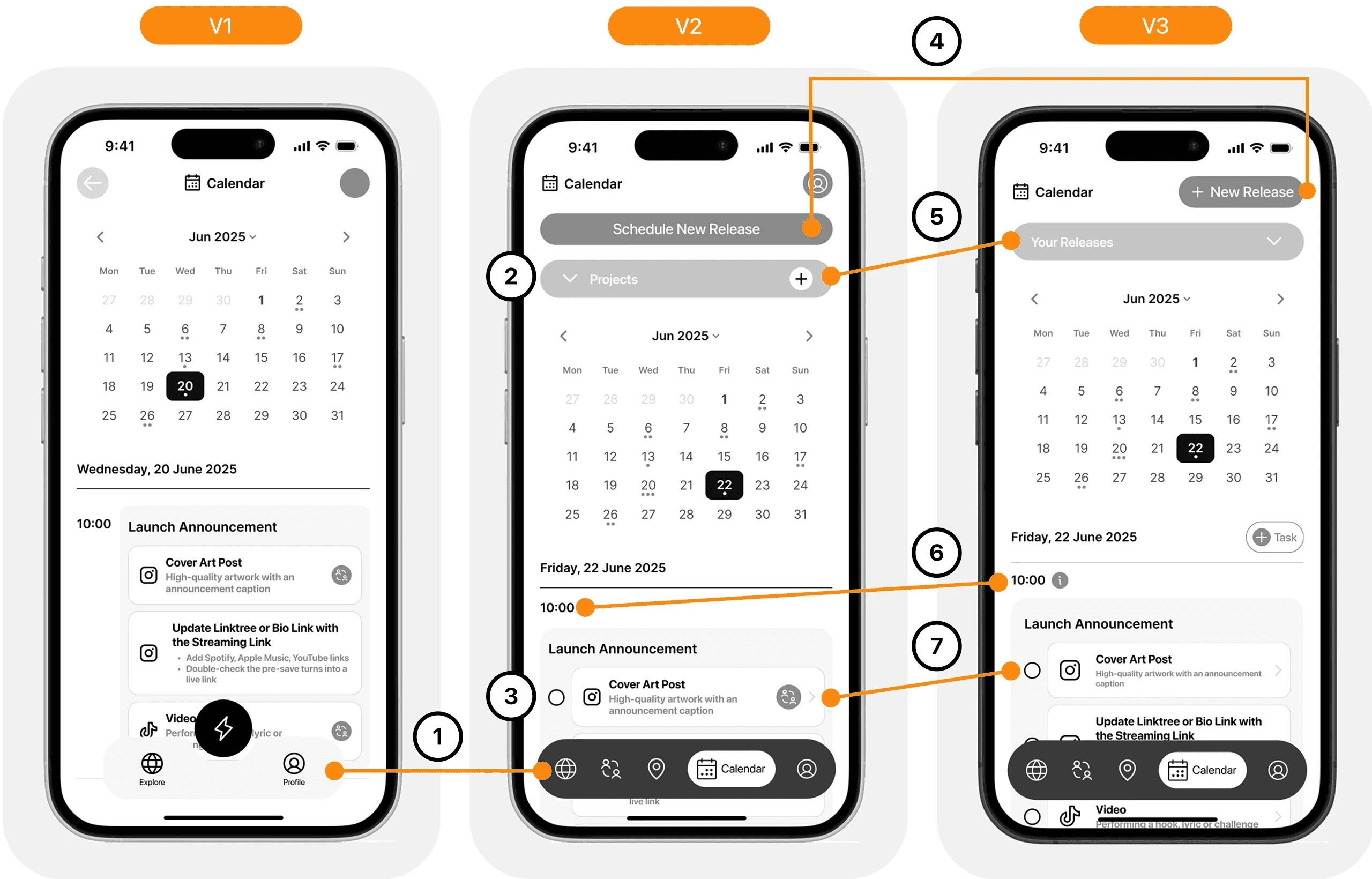
CALENDAR PAGE
Version 2
1
Created an updated navigation bar. Instead of being action-focused, more general and scalable
2
Categorization by project for better organization
3
Ability to check of tasks as complete/mark as done
Version 3
4
More concealed CTA for new releases to allow for more breathing room of the existing calendar
5
Change in UX copy from "Projects" to "Releases" to align better with usr expectations
6
Added an information icon to provide more data-driven context regarding timing and content recommendations
7
Reduced possible actions on task cards to avoid small tap targets
PHASE 4 - BRANDING
BRAND DEVELOPMENT
Having understood the main value my product would bring, it's features and functionalities, I began thinking about the kind of brand I wanted to build around the platform.
NAME SELECTION
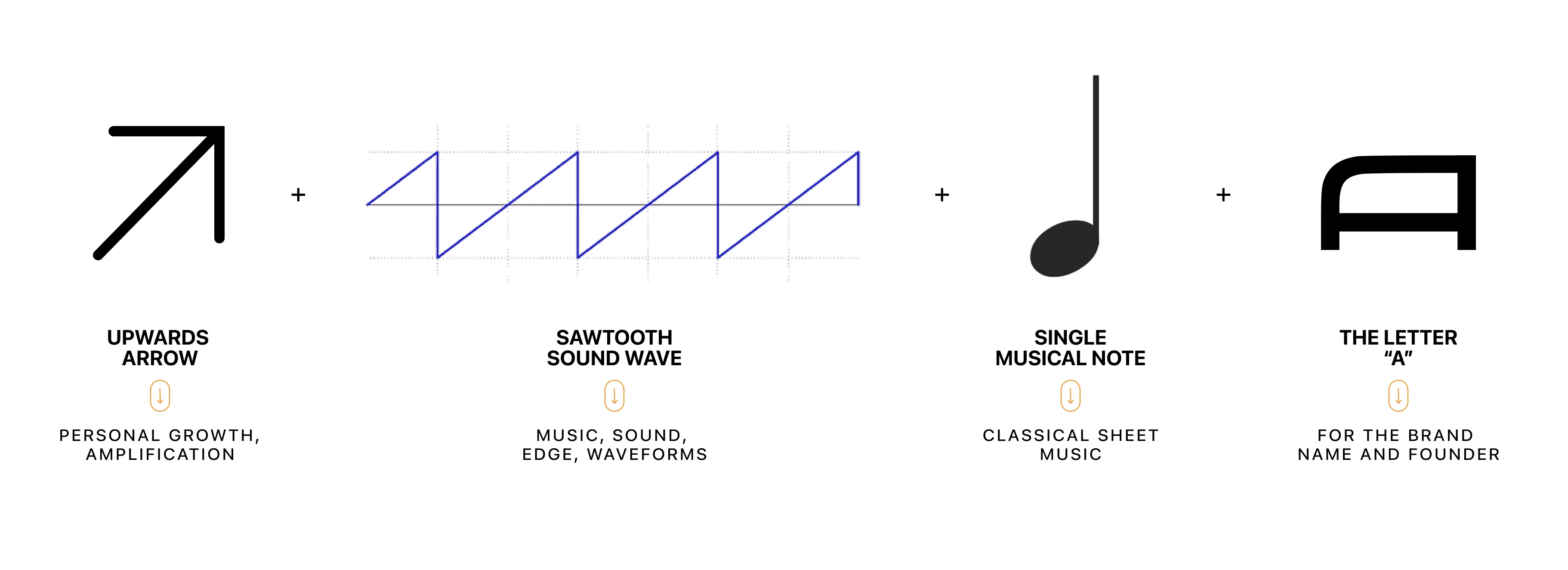
The concept of amplification stuck with me. It came across as a clear metaphor associated with sound and music while also symbolizing growth, connection, and visibility.
From there, I locked onto Amplify but as I continued to use it, it felt predictable and lost in the sea of “-ify” startups. I chose AMP instead: bold, direct, and memorable. It captures the same spirit of elevating artists while giving the brand a stronger, more distinctive identity.
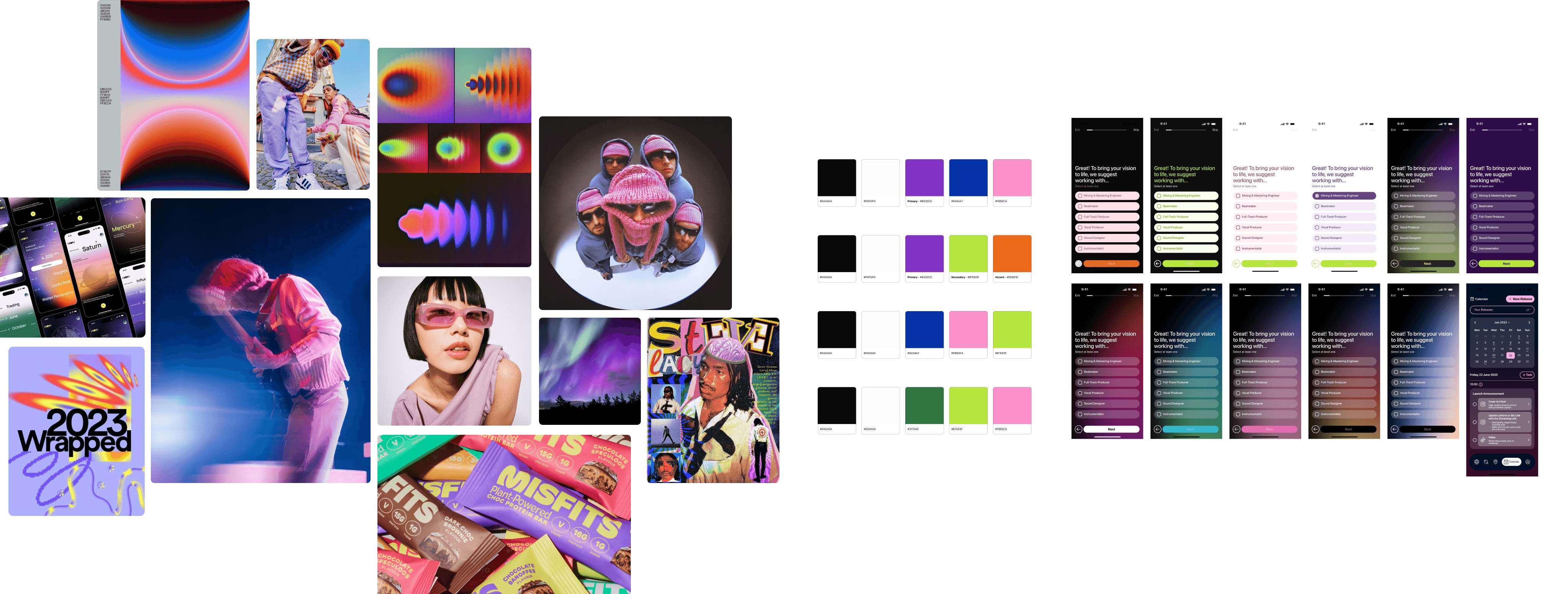
COLOR EXPLORATION
My initial vision for the application was inspired by funky, retrofuturistic music culture and bold LED-light colours that you'd find at a concert. But, after injecting the various colour schemes from the original exploration into the wireframes, I felt like the effect it had wasn’t what I intended.
This art direction once implemented was associated with astronomy or space or even a more sport-oriented aesthetic with the lime green.
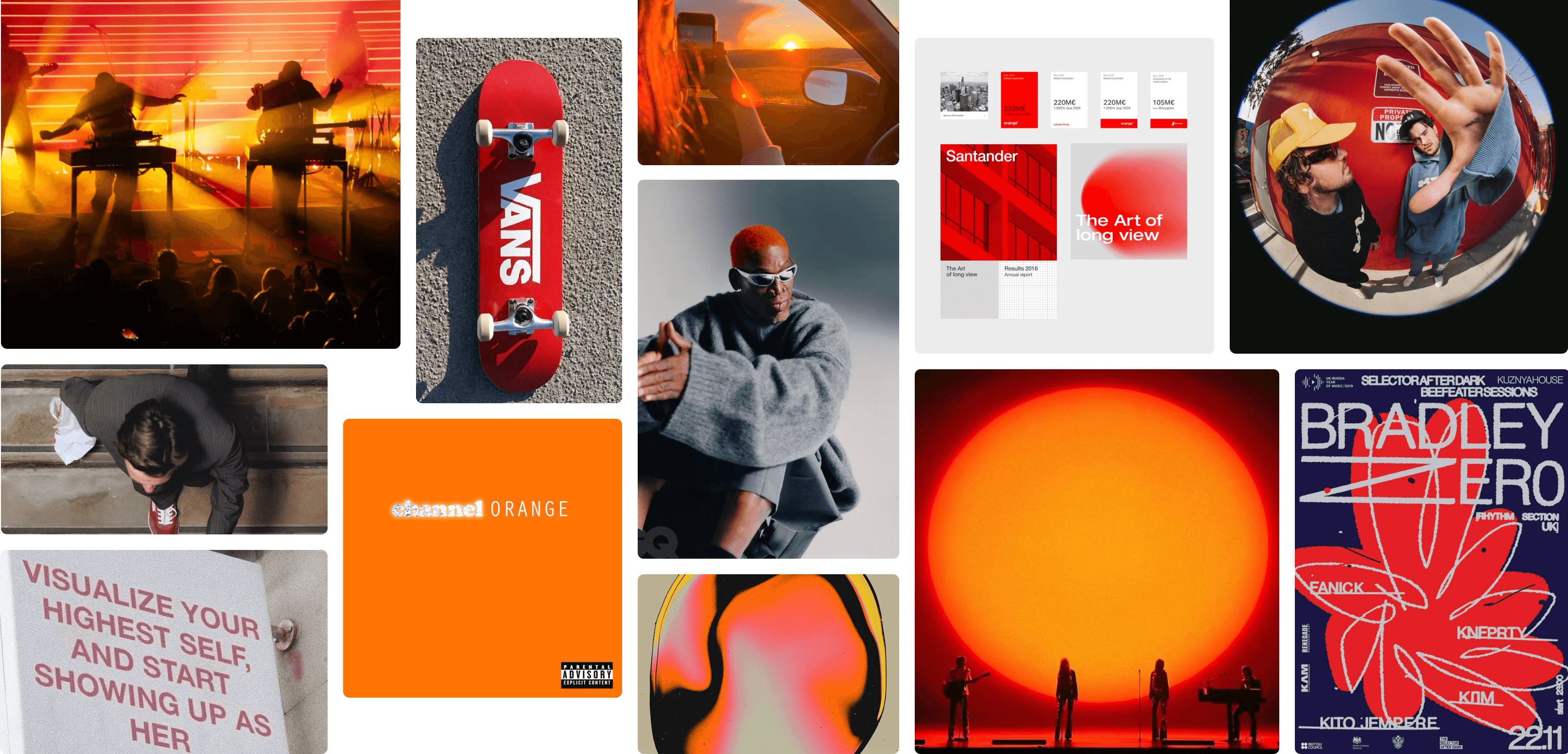
REFINED MOODBOARD
So I went back to the drawing board and tried to pull back and simplify into a new vision for the brand that still represented the keywords I had in mind.
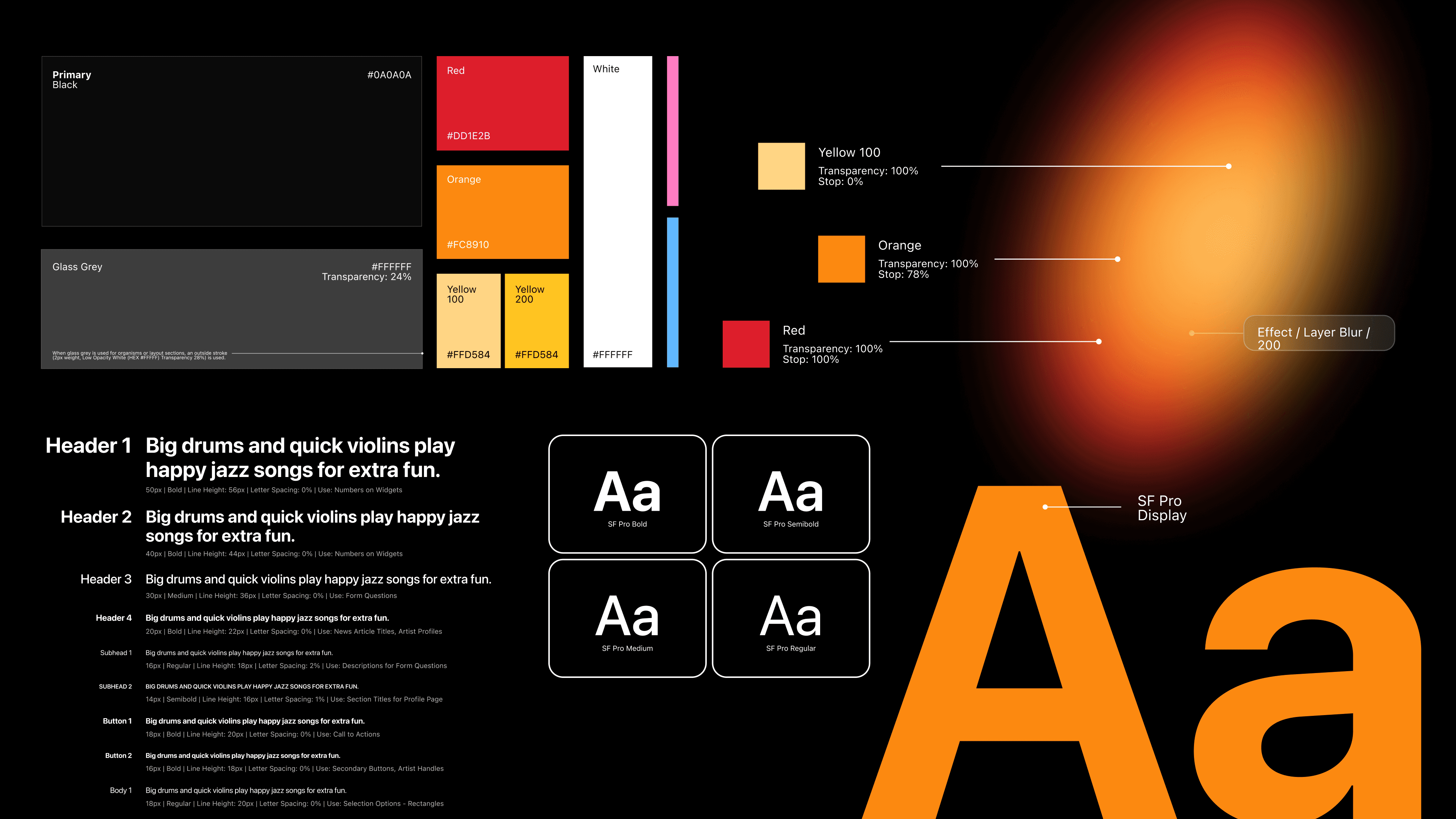
I focused on building a warmer palette, inspired by skater and music culture, what it means to be trendy and bold today.
WORDMARK
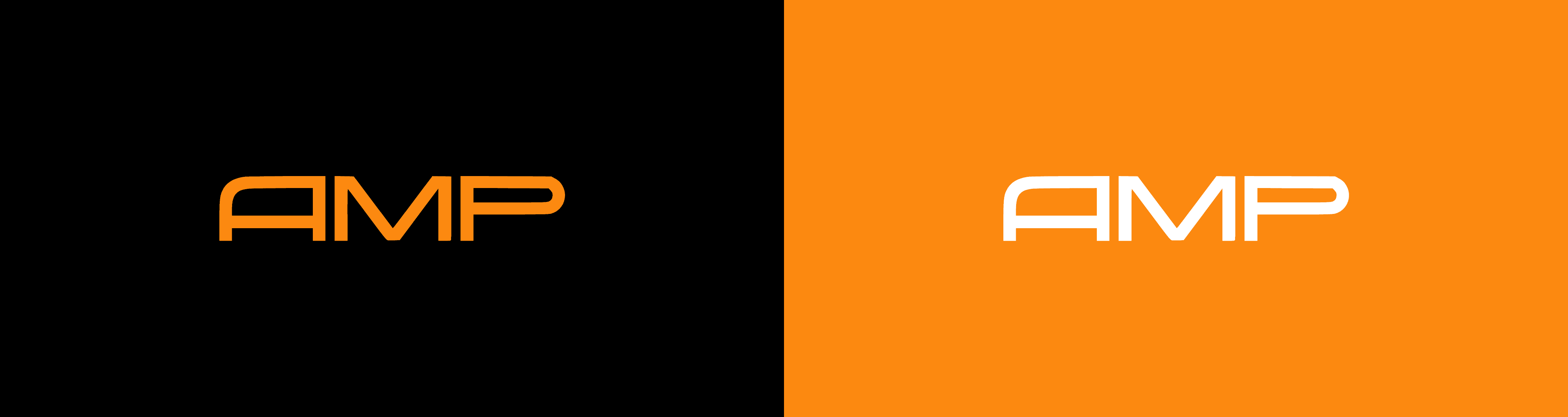
The typeface I chose to express the wordmark is Tekno sourced from Good Type Foundry.
Tekno is an extended display typeface with technologic features available in one weight/two styles. The extended width gives the text a stretched, rhythmic quality which can visually mimic beats or waveforms, creating a subconscious tie-in with music.
WORDMARK
The typeface I chose to express the wordmark is Tekno sourced from Good Type Foundry.
Tekno is an extended display typeface with technologic features available in one weight/two styles. The extended width gives the text a stretched, rhythmic quality which can visually mimic beats or waveforms, creating a subconscious tie-in with music.
UI LIBRARY
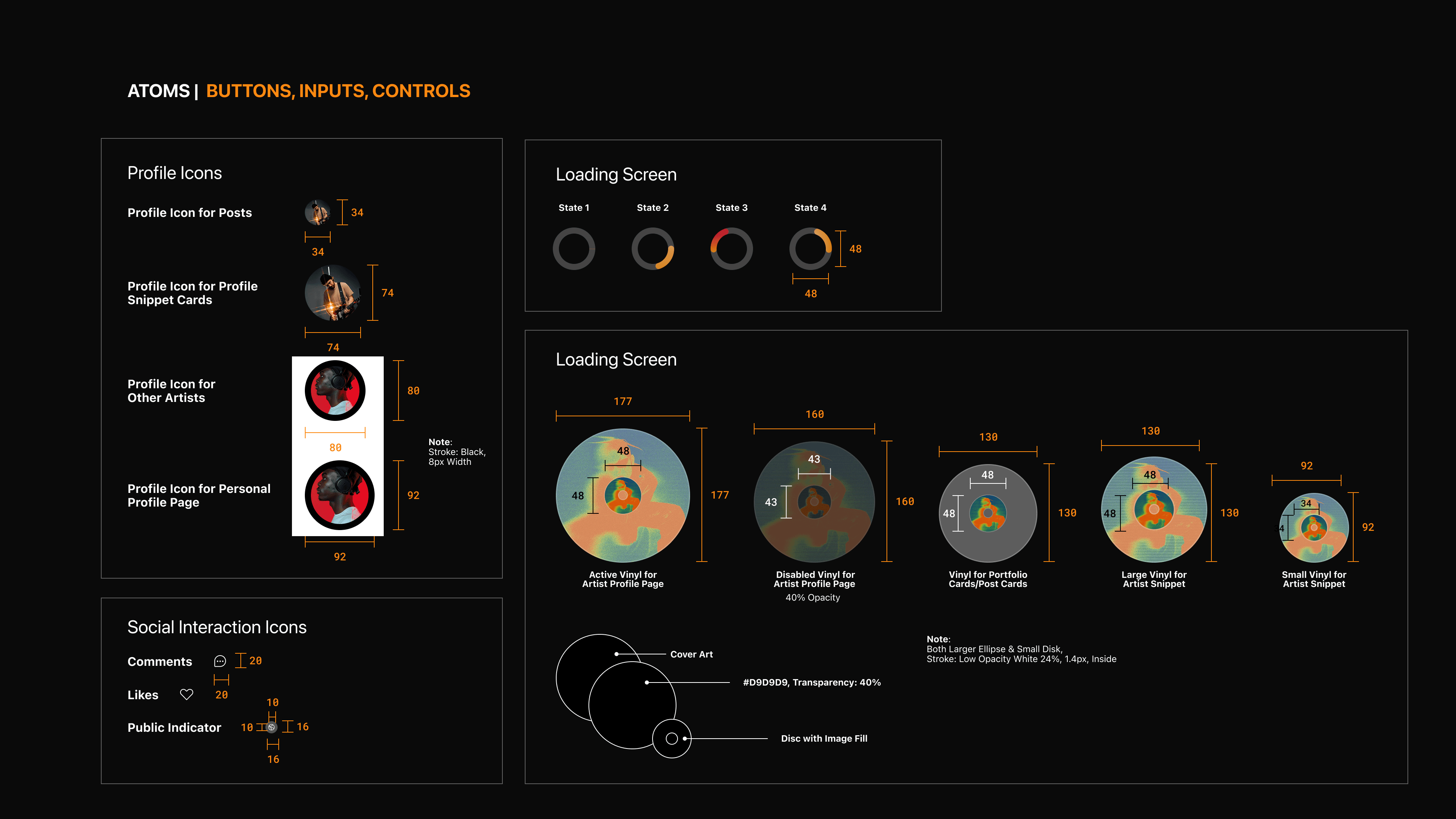
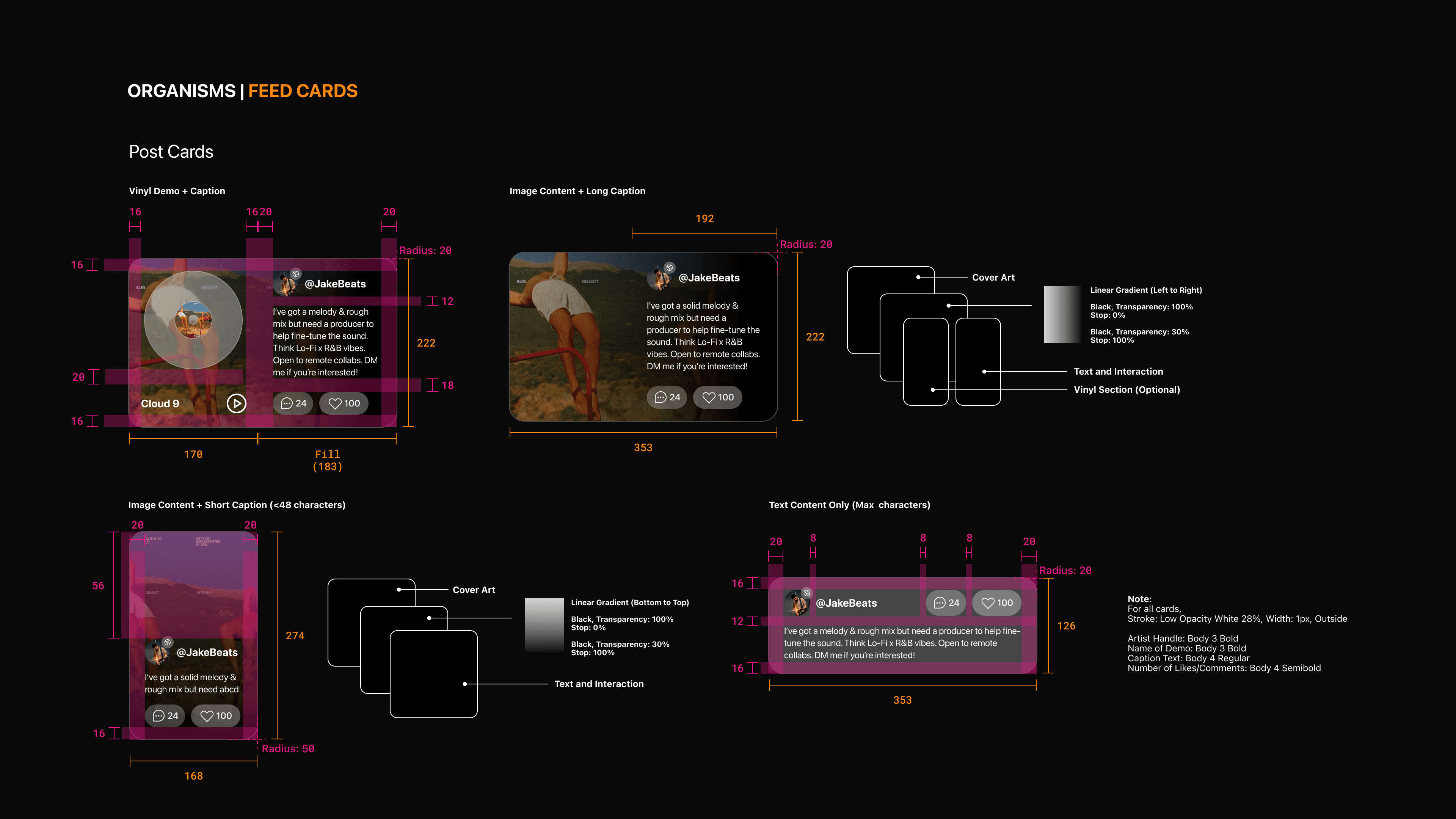
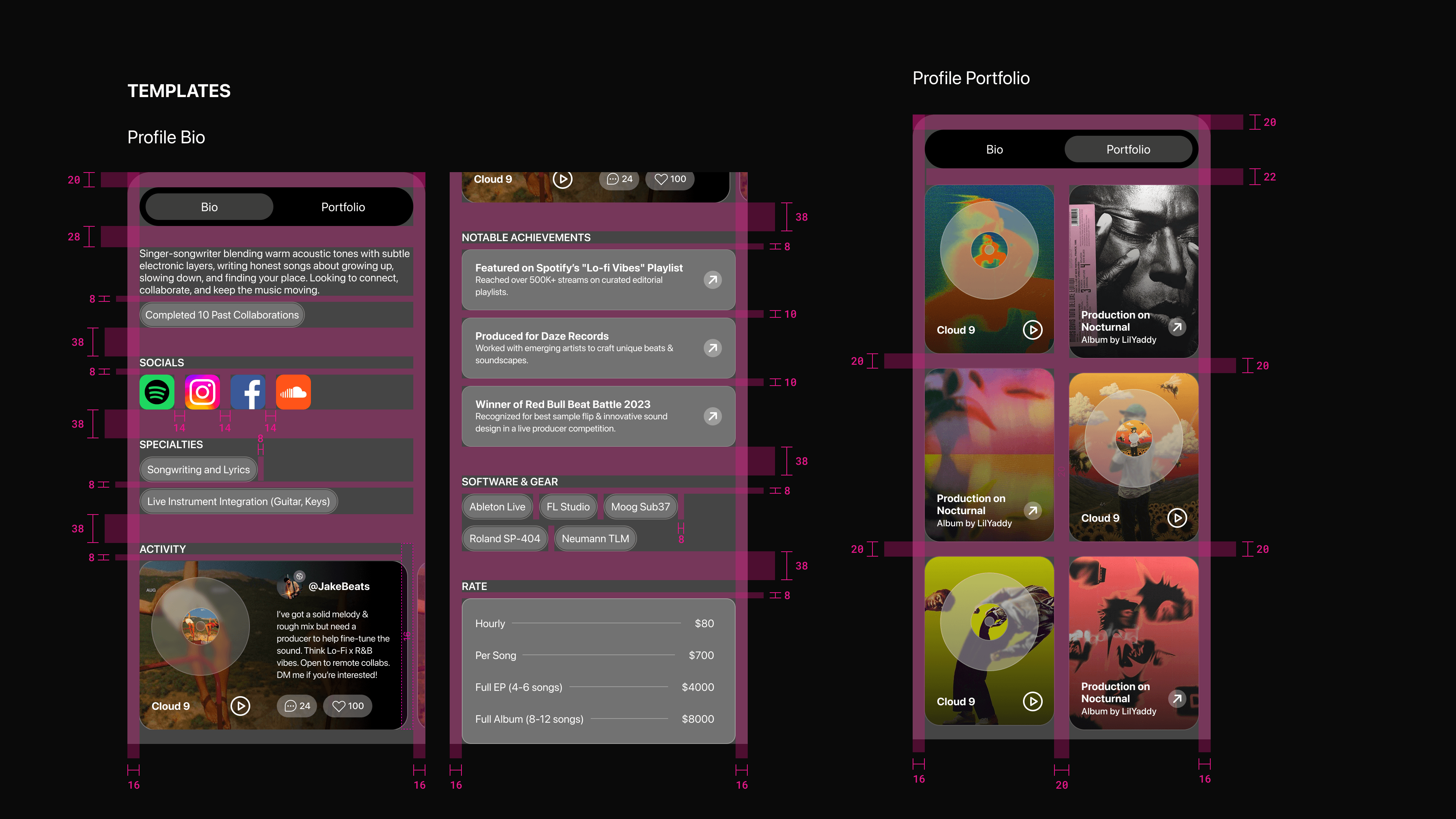
I used the Atomic Design Methodology to ensure consistency and scalability across the product.
This system made it easier to maintain visual cohesion, iterate quickly, and design with flexibility as new features were added. It also laid the groundwork for developer handoff and future design scaling. I also tried to align the UI library with my design aesthetic to allow for continuity in terms of bra